
Is the Crorebet App Safe? Our Security Assessment
The Crorebet app behaved safely in our checks: traffic ran encrypted on every screen we inspected, and it asks for nothing a casino platform cannot justify. The real exposure sits in your account rather than in the software, so a unique password and a locked mobile number matter more than the app itself.
Secure the account on day one
Unique password, notifications on, one-time password confirmation for new devices.
Set Up Your Account- 18+ only
- Six permissions only
- Encrypted in transit
- No SMS access
- ₹0 to install
What data does the app handle, and what can you control?
Five categories, and only two of them are genuinely optional. The install-time permission list belongs on the APK file guide; what follows is about the information that flows once you are logged in and using the account week after week.
| Data | Why the app has it | Your control | Sensitivity |
|---|---|---|---|
| Identity documents | Verification before a first payout; PAN or Aadhaar-based check | Mandatory to withdraw | High |
| Bank account reference | IMPS payouts leave to a named bank account only | Mandatory to withdraw | High |
| Registered mobile number | Login codes, deposit confirmations, account recovery | Mandatory; changeable in settings | Medium |
| Device and network identifiers | New-device detection and fraud checks | Not adjustable | Medium |
| Usage and play activity | Game settlement, bonus tracking, personalised promotions | Promotions opt-out only | Medium |
| Uploaded screenshots | Attachments you add to support tickets | Fully optional | Low |
| Push notification token | Match alerts and settled-bet messages | Deny or revoke anytime | Low |
Last verified: 20 August 2026, compiled from the cashier, verification and settings screens on a Redmi Note 12 (Android 13) over Jio 4G in Pune.
The practical implication is worth stating plainly: verification data is the highest-value information in the account and it is not optional if you intend to take money out. That trade is inherent to a regulated-style payout process rather than specific to this platform, and the document list itself is covered on the registration and verification page.
On this page
Is the connection encrypted on every screen?
Yes, on every screen we opened during a two-hour inspection on 19 August 2026. We walked the casino platform lobby, an live casino category, the deposit form, the withdrawal request, the document upload and the live chat, and each session negotiated an encrypted connection before any field accepted input.
Definition: TLS
Transport Layer Security is the protocol that encrypts data travelling between your phone and a server, so that anyone able to observe the network sees unreadable traffic rather than your password or account number. It protects data in motion. It does nothing about how that data is stored after it arrives.
What that finding is worth is limited and specific. Encryption in transit removes the network from your threat model, which is why a hostile café hotspot is a far smaller problem in 2026 than it was a decade ago. It does not tell you whether documents sit encrypted at rest on the operator's servers, how many staff can open them, or whether logs retain your bank reference. Those are the questions we cannot answer, and the section on our limitations further down is deliberately blunt about it.
One additional observation from the same session: the app reissued a login challenge when we opened the account on the second test handset, a Redmi 9A, on 20 August 2026. New-device detection working in practice is more reassuring than a policy page claiming it exists.
Which account controls should you switch on immediately?
Three, and they take four minutes together. Every serious loss in this category that we have looked into came through the account rather than through the software, so this is the section that actually reduces your risk.
Definition: two-factor authentication
Two-factor authentication requires two different kinds of proof before an account opens: something you know, such as a password, plus something you hold, such as a code delivered to your phone. A stolen password alone stops being enough, which is what makes it the single most effective control available to an ordinary user.
- Set a password used nowhere else
Credential stuffing is the most common attack on casino accounts because it needs no skill: attackers replay username and password pairs leaked from unrelated sites. A unique password ends that attack completely, and a password manager removes the excuse for not having one.
- Keep one-time password confirmation active for new devices
Leave the code challenge switched on so that a login from an unfamiliar handset needs your phone as well as your password. Login mechanics, code delivery failures and lockout recovery are documented on the login and one-time password page.
- Review sessions and notifications monthly
Open the account settings, end any session you do not recognise, and keep push notifications on so that a deposit or payout you did not request reaches you within seconds rather than at month end.
Set the payout bank account once and then leave it alone. An attacker who gets into an account usually cannot extract money without changing the registered bank details, so an unexpected prompt about that change is your loudest warning signal.
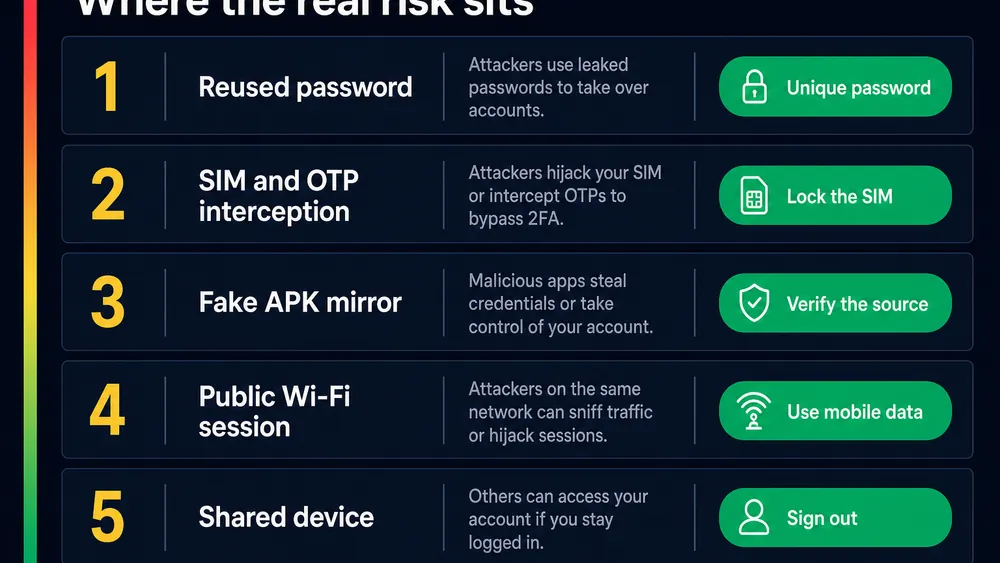
What are the realistic risks, in order?
Five, ranked by how often they actually cost people money rather than by how alarming they sound. Malware inside the genuine application is not on the list, because we found no indication of it and because the attacks below are what practitioners see instead.
| Risk | Likelihood | The specific mitigation |
|---|---|---|
| Credential reuse from an unrelated breach | High | A password unique to this account, stored in a manager |
| Phishing pages imitating the brand | High | Reach the app only from your own launcher icon or a bookmark, never from a message |
| Repackaged installer from a third-party site | Medium | One download source, the 28–43 MB size check, and a permission re-read after every update |
| SIM-swap attack on your code delivery | Medium | A port-out lock at your telecom provider; treat sudden signal loss as an incident |
| Shared or public Wi-Fi | Low | Encrypted traffic covers most of it; still use mobile data for cashier actions |
Read the ordering carefully, because it contradicts the way this subject is usually discussed. The two highest-likelihood risks have nothing to do with the application's code and everything to do with habits: reusing a password, and trusting a link. Both are free to fix. The repackaged-installer risk is the one that connects to the file itself, and the way a fake platform differs from a fake file is set out on our verification investigation.
Install once, from one source
43 MB · version 3.6 · six permissions · Android 8.0 and above.
Get the Official File- UPI
- PhonePe
- Google Pay
- Paytm
- IMPS
How do you spot a phishing clone?
By checking the address before you check the page, because a convincing copy is trivial to build and impossible to spot from the design alone. Cloned casino pages are cheap: attackers copy the real interface wholesale, host it on a similar-looking domain, and drive traffic through messages promising a bonus.
- Read the domain character by character. Substituted letters, added hyphens and unfamiliar extensions are the whole trick. A brand name appearing somewhere in a long address proves nothing.
- Distrust arrival by message. Links forwarded in chat groups, promotional messages and comment replies are the standard delivery route. Open the app from your own launcher instead.
- Treat urgency as a signal. A bonus expiring in ten minutes exists to stop you checking the address. Genuine promotions survive a thirty-second pause.
- Never type a login code into a chat. No support agent needs your password or your one-time code. A request for either identifies the person asking as an attacker.
- Watch for a payment page that changes rails. A cashier that suddenly asks you to send money to a personal account or a wallet handle is not a cashier.
- Check the encryption indicator, then keep going. A padlock means the connection is encrypted, not that the site is honest. Phishing pages have encryption too.
If you entered credentials into a page you now doubt, change the password immediately from a device you trust and then read the compromise procedure below. Speed matters more than certainty here — a password change costs you a minute and closes the window if you were right.
A twelve-point device-safety checklist
Everything below is free, takes under fifteen minutes in total, and applies to any real-money app on your phone rather than to this one specifically.
- Set a screen lock with a biometric or a six-digit PIN, not a four-digit one.
- Use a password for the casino account that appears on no other service.
- Keep the login code challenge switched on for logins from new devices.
- Install the app once, from a single source, on the phone that will run it.
- Confirm the installer size sits in the 28–43 MB range before opening it.
- Switch the unknown-sources permission back off once installation finishes.
- Re-read the app's permission list after every manual update.
- Keep Android security updates current, even on an older handset.
- Leave Play Protect enabled so on-device scanning continues after install.
- Ask your telecom provider to place a port-out lock on your number.
- Use mobile data rather than shared Wi-Fi for deposits and withdrawals.
- Withdraw your balance rather than leaving it parked in the account.
The last item is the one people ignore and the one that limits every other failure. A compromised account with a ₹400 balance is an annoyance; the same compromise with ₹40,000 sitting in it is a different afternoon. Payout timing evidence that makes frequent withdrawals practical is logged on our payout test record.
What should you do if the account is compromised?
Work in this order, because doing step four before step one wastes the only window you have. The sequence assumes you have noticed unfamiliar stakes, an unexpected withdrawal request, or a login alert you did not trigger.
- Change the password from a device you trust
Set a new password used nowhere else. Everything after this is pointless while the intruder still holds working credentials.
- End every other session
Use the session or device list in settings to close all sessions except your own. If the control is not there, ask support to force a sign-out across devices.
- Screenshot the unauthorised activity
Capture game history, the transaction list and any pending payout with timestamps visible. Evidence gathered before you complain is worth far more than a description written afterwards.
- Open a ticket and ask for a payout freeze
Report it through live chat, give exact times for the activity you did not authorise, and request that withdrawals be held while it is reviewed. The escalation ladder if the first reply misses the point is on the customer care page.
- Verify your registered details
Confirm the payout bank account and mobile number are still yours. Changing those is normally the attacker's objective, and reversing it early is much easier than arguing about it later.
- Rotate the password everywhere it was reused
If the same password protected your email or a shopping account, treat those as compromised too and change them before the credential is replayed.
- Withdraw what remains
Once access is secure, take the balance out. An account that has already been attacked once is not the place to leave money while you decide what happened.
What we cannot assess from the outside
A great deal, and saying so is the only honest way to publish a security page. Everything above was measured from a phone and a network connection, which means our findings stop at the boundary of the operator's infrastructure.
We cannot see how identity documents are stored once uploaded, whether they are encrypted at rest, or how long they are retained after an account closes. We cannot see internal access controls: how many staff can open a verification record, whether that access is logged, or whether contractors are involved. We have no breach history to examine, because none has been disclosed and absence of disclosure is not the same as absence of incident. There is no published penetration-test summary, no security certification, and no bug-bounty programme through which independent researchers would surface findings.
Those gaps are not unique to this operator — most India-facing casino brands publish nothing in this area — but they are real, and they are why our score below stops well short of five. The methodology behind that scoring, including how we weight things we cannot verify, is set out on our testing page.
Verdict on app and account safety
Pros
- Encrypted transport on every screen inspected on 19 August 2026
- Six permissions only, with no SMS, contacts or accessibility access
- New-device login challenge fired correctly on our second handset
- Verification data collected at payout stage rather than at sign-up
- Notification and promotion permissions are genuinely optional
- Support reachable in Hindi within minutes if you need a session closed
Cons
- No published security certification or penetration-test summary
- Storage, retention and staff access to documents are invisible to us
- No breach-disclosure history to judge incident handling against
- Device identifiers are collected with no user-facing control
- Codes arrive by message, so a SIM-swap attack remains viable
The assessment in one paragraph: the software is not where your risk lives. It asks for little, encrypts what it sends, and challenges an unfamiliar device, which puts it in reasonable shape for a sideloaded casino client. The risk lives in a reused password, a forwarded link and an installer from the wrong website, and all three are inside your control. What we cannot grade is everything behind the server boundary, so treat this as a verdict on the client and your habits rather than a clean bill of health for the whole operation. Fault-finding for crashes and login failures continues on the troubleshooting matrix.
Checks done, account secured
₹0 to install · encrypted in transit · Hindi and English support.
Download Crorebet App- 18+ only
- Anjouan licensed
- No SMS permission
- IMPS payouts
- Losses are likely
Frequently asked questions
Is the Crorebet app safe to keep on my phone?
On our checks it behaves like a normal casino platform client: six permissions, no SMS or accessibility access, and encrypted traffic on every screen we inspected on 19 August 2026. The residual risks are account-level rather than app-level, which is why a unique password matters more than anything else here.
Crorebet app safe hai ya nahin?
App ka behaviour theek tha: sirf chhe permission, SMS ya contacts ka access nahin, aur har screen par encrypted connection. Asli khatra password reuse aur fake copy apps se hai, isliye unique password rakhein aur file sirf ek hi source se install karein.
What data does the app collect?
Identity documents for verification, a bank reference for payouts, your registered mobile number, device and network identifiers, and in-app usage data such as stakes placed and screens visited. Verification data is mandatory before a first withdrawal; notification and analytics permissions are not.
Is my connection encrypted?
Every screen we inspected on 19 August 2026 loaded over TLS, including the cashier, the deposit form and the document upload. That protects data in transit between your phone and the servers, and says nothing about how it is stored once it arrives.
Should I use the app on public Wi-Fi?
Encrypted traffic makes a hostile hotspot far less dangerous than it used to be, but avoid depositing or withdrawing on shared networks anyway. Mobile data costs a few rupees for a cashier session and removes an entire class of risk from the picture.
How do I spot a fake Crorebet page?
Check the domain character by character, distrust any page reached from a message or an advertisement, and treat urgency about a bonus expiring as the warning sign it is. A real operator never asks for your password or your one-time password in chat.
Can someone steal my account through the OTP?
A SIM-swap attack is the realistic route, where an attacker persuades a mobile operator to reissue your number and then receives your codes. Lock your number with a port-out restriction at your telecom provider and treat an unexplained loss of signal as an emergency.
What can you not assess about this app?
Anything server-side: how documents are stored, who inside the company can read them, how long data is retained, and whether there has ever been a breach. No external tester can answer those without an audit report, and none is published.